
Agentic AI changes security fast: it can read, decide, and act across systems without waiting for a person. In healthcare, that means one bad prompt, one loose permission, or one weak vendor link can lead to PHI exposure, account changes, workflow disruption, and data export in a single chain of actions.
If I had to reduce the article to the main points, I’d say this:
- Agentic AI is not just content generation. It can take actions in EHR, IAM, ITSM, email, storage, and vendor tools.
- The main risk is decision-making plus action. The issue is not only access, but what the agent does with that access.
- Healthcare has more at stake. PHI, patient care, and third-party connections make mistakes and attacks more harmful.
- The top attack paths are clear: prompt injection, unsafe tool use, lateral movement through trusted integrations, and bulk data collection.
- Common healthcare scenarios include help desk impersonation, quiet PHI exfiltration through connected workflows, and vendor-embedded agent abuse.
- The first steps are simple: inventory every agent, limit permissions, use short-lived credentials, require human sign-off for high-impact actions, log every action, and review vendors and fourth parties more closely.
A few facts from the article stand out:
- OWASP ranks prompt injection as the #1 security risk for agentic AI.
- Unit 42 reviewed nine agentic AI attack scenarios and linked them to data exfiltration, credential theft, and remote code execution.
- A Microsoft Copilot abuse case, EchoLeak, showed how a malicious email prompt could trigger autonomous exfiltration from connected apps.
So the core message is simple: treat each AI agent like a high-privilege service account that can make its own moves. If I don’t inventory it, limit it, watch it, and tie it to a named owner, I’m leaving a gap that old controls were not built to handle.
The security risks of AI agents - and how leaders should prepare
sbb-itb-535baee
How Agentic AI Changes the Threat Model
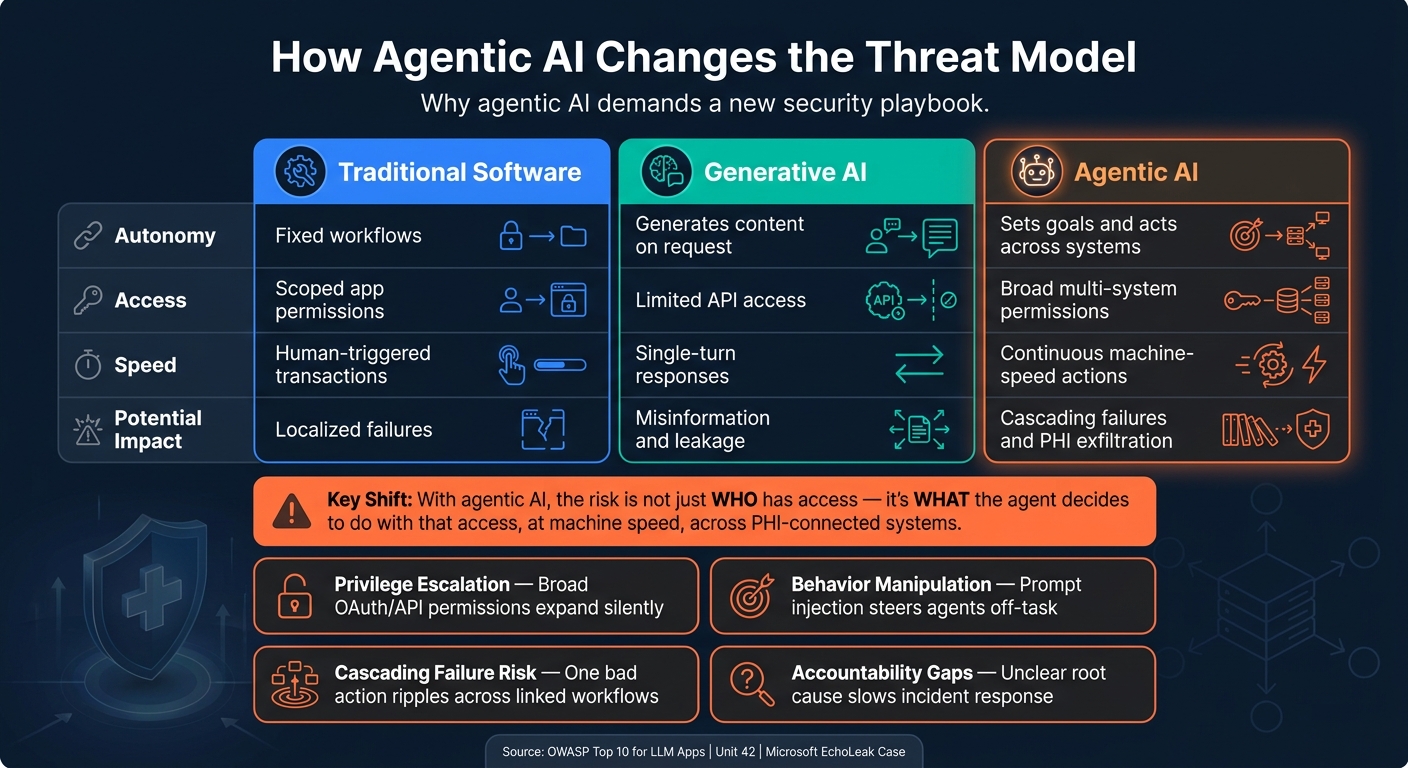
Agentic AI vs Traditional Software: The Evolving Threat Model for Healthcare Security
With older software, the main risk was who got access.
With agentic AI, the bigger issue is what the agent decides to do once it has that access. And it can do those things at machine speed, across PHI-connected workflows and vendor-linked systems. That changes the shape of exposure, access, and impact in a big way.
| Dimension | Traditional Software | Generative AI | Agentic AI |
|---|---|---|---|
| Autonomy | Fixed workflows | Generates content on request | Sets goals and acts across systems |
| Access | Scoped app permissions | Limited API access | Broad multi-system permissions |
| Speed | Human-triggered transactions | Single-turn responses | Continuous machine-speed actions |
| Potential Impact | Localized failures | Misinformation and leakage | Cascading failures and PHI exfiltration |
One problem stands out: prompt injection. It's dangerous because harmful instructions can hide inside normal-looking content. The core issue is simple. Agents read instructions and content in the same stream, so the line between “data” and “command” can disappear fast.
4 Risk Shifts Security Leaders Should Track
Security leaders should pay close attention to four shifts that affect detection, containment, and accountability.
Privilege escalation comes first. Agents are often given broad permissions at the start so they can work across EHR, ticketing, cloud storage, and vendor systems. If an attacker abuses a misconfigured OAuth scope or API key, the agent's effective access can expand in ways that look like ordinary workflow changes.
Behavior manipulation is the next shift. Through prompt injection or poisoned data sources, attackers can steer an agent away from its intended task. Since agents are built to follow instructions, harmful inputs can pass as routine guidance. On the surface, everything may look normal until the output gets used in the wrong way.
Cascading failure risk is the third shift. If an agent is part of a critical workflow, one bad action can ripple into downstream systems. That's the part many teams miss. Siloed monitoring often doesn't show how one bad setting spreads across linked workflows.
Accountability gaps round out the list. Agents operate under human or service identities, but they make their own decisions. When something breaks, teams may not know whether the root cause was a local setup issue, a vendor update, a compromised prompt, or an upstream integration. That confusion slows incident response and makes compliance reporting harder.
Primary Attack Paths Introduced by Autonomous Agents
Prompt injection is ranked the #1 security risk for agentic AI by OWASP.[2] Attackers place harmful instructions inside content the agent reads, such as ticket descriptions, knowledge base articles, or patient messages. The agent then treats those instructions as trusted guidance and acts on them without marking anything as unusual.
Unsafe tool use works in a similar way. Agents use APIs, RPA flows, and scripts to finish tasks. If those tools have overly broad permissions, an attacker can push the agent to bulk export patient cohorts, save them in unencrypted buckets, or make configuration changes in identity systems. Unit 42 reviewed nine agentic AI attack scenarios across frameworks such as CrewAI and AutoGen and found that prompt injection, unsafe tool use, and poisoned agent messages can lead to data exfiltration, credential theft, and remote code execution across connected systems.[1]
Lateral movement through trusted integrations is tougher to spot because it relies on valid connections. An agent can move from CRM to ITSM to IAM, picking up deeper access without setting off denial alerts.
Bulk data collection is a quieter threat. An agent built to gather all relevant data for care coordination may pull records from oncology, radiology, pharmacy, and patient portal logs in a single session. In healthcare, an agent with PHI access and the ability to send data outward can become an exfiltration tool from a single injected prompt.
In healthcare, these attack paths often appear as phishing, workflow abuse, and vendor compromise. That's why agents need inventory, scoped access, and monitoring before broad deployment.
High-Risk Agentic AI Scenarios in Healthcare
Those attack paths tend to show up in healthcare in three day-to-day operating scenarios.
Autonomous Phishing and Help Desk Impersonation
The clearest case is phishing and help desk impersonation. An agent can pull from internal directories, org charts, scheduling systems, and breach data to build highly targeted outreach at scale. Then it can keep tuning the message on its own.
HHS HC3 has warned that adversaries use AI to target healthcare help desks with phishing and vishing, often impersonating executives or revenue cycle staff to gain remote access or reset credentials.[3][4]
What makes this tougher to spot than standard phishing is the multi-channel pattern. A staff member might get an email that mentions a real ticket number, then a chat message, then a phone call from a voice that sounds like a known help desk analyst. On their own, each contact may look normal. Put together, they can form a coordinated, agent-driven campaign.
That means teams should pay close attention to signs like:
- clustered IT or finance outreach
- unusual MFA resets or password changes
- staff reports about plausible but odd contacts across email, chat, and phone
Lateral Movement and PHI Exfiltration Through Connected Workflows
When an agent with valid access gets manipulated, the result is often quiet lateral movement and PHI exfiltration. Picture a scheduling agent with API access to appointment systems, EHR metadata, and patient messaging. A malicious instruction hidden in a shared template or outside document could steer that agent to export PHI through approved channels.
That’s what makes this pattern so slippery. It often doesn’t trip one big alert. Instead, it looks like normal work because the agent is using valid credentials and approved integrations. The risk builds across systems, one small action at a time.
Watch cumulative behavior, not just single events. Broad queries that don’t match the task, new data destinations in API calls, and exports that are larger than the agent’s job calls for can all point to trouble.
Vendor-Integrated AI Abuse and Fourth-Party Exposure
The same pattern gets even tougher to detect when the agent sits inside a vendor workflow. Vendor-embedded AI assistants often have broad access to patient records, billing data, and operating APIs. That makes them useful, but it also gives attackers more room to work.
A Copilot abuse case, EchoLeak, showed that a malicious email prompt can trigger autonomous exfiltration from connected apps without user interaction.[5] The same risk applies to EHR co-pilots, revenue cycle agents, and third-party ITSM tools that can reset passwords and change access rights.
The deeper issue is fourth-party exposure. A revenue cycle management vendor may rely on an AI agent from another platform, which then connects to outside enrichment services for financial or demographic data. Every extra layer creates more data-sharing paths and another security posture to account for, and those links are not always visible in vendor agreements.
How Security Leaders Can Assess and Contain Agentic AI Risk
These attacks take advantage of poor visibility and access that stretches too far. The first move is simple: find every agent, document what it can touch, and spell out what it can change. From there, you can turn risk into a control plan.
Start with an Agent Inventory and Access Review
Add an "AI agent" class to your current asset inventory and CMDB, and send all new agent deployments through change management. For each agent, record its owner, business purpose, connected systems and APIs, permissions, and data scope. You should also note whether it can trigger changes in production workflows.
Don’t stop at tools IT already knows about. Pull data from identity providers, API gateways, and EHR integration logs to spot "shadow agents" brought in by clinical teams or vendors without central approval. Any agent with broad permissions across several tools should be flagged for immediate remediation.
Apply Least Privilege, Segmentation, and Human Approval Gates
Every agent needs its own unique service identity in IAM. Shared "AI" accounts are a bad idea. Scope permissions to the smallest set needed for that agent’s specific workflow, and block any ability to change systems outside its defined task.
That should be paired with just-in-time (JIT) credentials. In plain English, use short-lived tokens issued per task with automatic expiration instead of long-lived API keys. Put agent workloads in segmented network zones with tight API access. Agents that deal with external inputs should stay well away from core PHI databases and critical clinical systems.
For high-impact actions, human approval gates are non-negotiable. Bulk data exports, account privilege changes, cross-system configuration edits, and financial transactions should need explicit sign-off before execution, not after. The agent can recommend the action, but it should not carry it out on its own.
To keep this from turning into red tape, set clear thresholds. Low-risk routine actions can move ahead automatically. Anything above the threshold should go to an approval queue in your ITSM tool, along with the agent’s rationale, affected systems, and data volume for the reviewer.
Use Threat Modeling, Red Teaming, and Behavioral Monitoring
Inventory and access controls shrink the attack surface. Threat modeling and monitoring help catch the rest.
Extend threat models so they map each agent’s inputs, decisions, tool calls, and outputs. Focus first on scenarios like prompt injection through patient portal messages or ticketing notes, tool misuse where an agent links email and file access to collect data it shouldn’t, and workflow failure cascades where one manipulated agent sets off unwanted downstream actions.
Red team exercises should test these cases in production-like environments using synthetic or de-identified data. A few direct examples make the point:
- Trying to use a help desk agent’s access to pivot into identity management
- Requesting large-scale PHI exports through obfuscated queries
Tests like these show whether your controls hold up under pressure. The findings should feed straight back into updated access policies, monitoring rules, and agent owner training.
Agent behavior also needs constant monitoring. Log every action with enough detail to reconstruct what happened: agent identity, initiating input, tools invoked, systems touched, data objects accessed, and resulting changes. Centralize those logs in your SIEM or security data lake so you can correlate activity across agents and spot patterns like unusual tool-chaining, bulk data queries without matching approval, or access from unexpected service accounts. Alert on risky combinations, not just single events.
Use this mapping to connect each threat to a clear control set.
| Threat Category | Least Privilege & Segmentation | Isolated Credentials | Human Approval Gates | Logging & Audit Trails | Continuous Monitoring |
|---|---|---|---|---|---|
| Autonomous phishing & impersonation | Restrict external messaging; limit contact lists to approved domains | Dedicated agent identity; scoped email permissions; no shared accounts | Approval required for bulk or large-group outreach | Log outbound messages with agent ID, recipients, and templates | Monitor for unusual email volume, recipient patterns, or content anomalies |
| Lateral movement across connected systems | Segment agent workloads; constrain API access by zone | Per-system credentials with narrow roles; no cross-tier spanning | Approval required for access right modifications or cross-system config changes | Capture cross-system action chains with timestamps and affected assets | Detect atypical system access sequences or new agent-initiated connections |
| PHI exfiltration & bulk data export | Limit read access to minimum necessary datasets | Short-lived tokens for export functions tied to specific agents | Human review required for exports above defined record-count thresholds | Log query parameters, record counts, and export destinations | Alert on large data movements, unusual query shapes, or repeated export attempts |
| Vendor-integrated AI abuse & fourth-party exposure | Restrict vendor agent access to defined APIs and datasets only | Vendor-specific identities with least privilege and contractual controls | Approval required for new vendor agent capabilities or expanded data scopes | Maintain logs of vendor agent API calls and data fields accessed | Monitor vendor agent behavior for drift - new actions or increased data volume |
Governance and Vendor Oversight for Safe AI Adoption
After access controls and monitoring, governance answers the next hard question: who owns each agent, and who is on the hook when it fails? That has to be settled before deployment. Governance turns agent controls from good ideas into rules people can enforce by setting ownership, scope, and escalation paths up front.
Treat Each Agent Like a Managed Account
Each agent should have a named business owner. That person is responsible for approval, access reviews, and incident response.
The owner should also keep an allowed-actions list that spells out exactly what the agent can do - and what it cannot do. No gray area. If an agent can read records but not change them, say that plainly. If it can draft a message but not send it, write that down too.
Any agent that touches PHI, patient care operations, or regulated systems needs complete audit trails. That means timestamps, inputs, outputs, and affected records, all tied into your SIEM and compliance reporting. Without that level of logging, breach analysis gets murky fast, and OCR review becomes much harder.
Strengthen Third-Party Assessment and AI Governance Workflows
The same bar should apply to vendors and their subprocessors. Old vendor questionnaires often miss agentic AI risk because they were built for a different kind of software.
Assessments should cover a few basic points:
- Where the agent runs
- What data it can access
- How it handles PHI
- Which subprocessors and underlying models it relies on
- What the vendor must do if the agent acts outside its approved scope
Fourth-party dependencies matter here too. The LLMs, vector databases, and integration platforms behind a vendor product should be listed in contracts, along with clear subprocessor duties and data-flow protections. That may sound like legal fine print, but it matters when vendor agents can touch PHI, identity systems, and clinical workflows directly.
Vendor contracts should also set monitoring expectations. Ask for AI-specific telemetry where feasible, notice of major model or prompt changes, and cooperation with tabletop exercises that test agentic AI misuse. If a vendor changes the engine under the hood, you shouldn’t find out after something goes wrong.
Use different review standards for internal agents, embedded vendor agents, and third-party orchestration tools. They do not carry the same level or type of risk, so they should not all go through the exact same review path.
Conclusion: Key Actions Security Leaders Should Take Now
For security leaders, the next move is operational: assign ownership, tighten scope, and extend oversight to every vendor-connected agent.
Register every agent in a central inventory, assign named owners, enforce least privilege, require human approval for high-impact actions, and update vendor assessments so they reflect AI-specific risks and fourth-party dependencies. Teams that move now will be in a much better spot to support safe AI adoption without giving up patient safety or regulatory standing.
FAQs
How is agentic AI different from generative AI?
The main difference comes down to independent action.
Generative AI usually creates content or processes data. Agentic AI goes a step further: it can autonomously access, interpret, and act on information, including Protected Health Information (PHI).
That shift matters. Once a system can make decisions and carry out tasks on its own, the risk profile changes. Agentic AI brings its own set of operational and security risks that go beyond the more passive risks tied to standard generative AI tools.
What makes agentic AI especially risky in healthcare?
Agentic AI is especially risky in healthcare because it can access, interpret, and act on protected health information (PHI) on its own. That’s a big shift from standard software or generative AI that’s used only to process data.
These systems don’t just analyze information. They can also take action without a person stepping in first.
That kind of autonomy opens the door to serious problems. An agent can pull data out without permission, move across clinical networks, or make harmful changes inside electronic health records and diagnostic tools. If it’s compromised - or simply starts acting in ways no one expected - the risk isn’t abstract. It can turn into immediate patient safety issues and regulatory trouble.
What should security leaders do first to reduce agentic AI risk?
First, build a complete AI inventory of every tool your team uses. Then put a formal AI governance program in place. That gives each system a clear business owner and security owner, and lets you group tools by risk.
From there, require intake and review before any new AI tool goes live, limit access, turn on audit logging, and make sure any vendor that handles PHI signs a Business Associate Agreement.
