
An EHR breach can disrupt care, delay orders, trigger HIPAA review, and drag on for weeks. My main takeaway is simple: a written breach playbook lowers risk by telling each team what to do, when to do it, and who approves it.
Here’s the short version:
- Breaches hit more than IT. They can affect clinicians, privacy, legal, communications, and leadership, impacting enterprise risk across the organization.
- Playbooks cut delay. Teams can validate alerts, lock down accounts, start downtime steps, and preserve evidence without debating each move.
- They support HIPAA and HITECH work. Built-in decision points help document whether ePHI was accessed, changed, taken, or made unavailable.
- They help restore care safely. Recovery works better when teams use tested backups, fixed restore order, and clinical signoff.
- They reduce uneven response. Shared steps, owners, and timelines help hospitals avoid mixed messages and missed tasks.
- They need testing. Tabletop drills and restore drills show whether the plan works under pressure.
- They need updates. EHR changes, third-party risk from vendors, new interfaces, incidents, and rule changes should trigger review.
A few numbers make the case. In 2024, HHS OCR received 663 large breach reports affecting about 242.9 million people. In Verizon’s 2025 healthcare breach review, 44% involved ransomware. And the article points to more than $1 million in possible savings when breaches are contained in under 30 days.
Applying Modular Design to Maintain IR Playbooks at Scale
sbb-itb-535baee
Quick Comparison
| Area | With a playbook | Without a playbook |
|---|---|---|
| Containment | Clear steps and approvals | Delays and confusion |
| Clinical downtime | Pre-set workflows for orders and charting | Workarounds made up on the spot |
| HIPAA review | Documented decisions inside the workflow | Gaps, late review, weak records |
| Recovery | Tested restore steps and signoff | Higher chance of restore mistakes |
| Communication | One message across teams | Conflicting updates |
If I had to sum it up in one line, it would be this: an EHR breach playbook turns a chaotic event into a repeatable control.
What an EHR Breach Playbook Must Cover
Scope, Triggers, and Roles Across Security, Privacy, Legal, IT, and Clinical Teams
A breach playbook has to draw clear lines. If the scope, triggers, and roles are fuzzy, teams lose time right when they can least afford it.
Start with scope. The playbook should spell out every system it covers: the EHR, connected clinical systems, identity and remote access tools, and third-party apps that store or process ePHI.[3][9] For each asset, note what PHI could be exposed and whether that system supports patient-care work such as medication ordering or results review.
Triggers need the same level of detail. That includes account issues like impossible travel logins or unusual MFA prompts, broad chart access across unrelated service lines, DLP alerts tied to mass PHI downloads, ransomware signals, or a vendor-reported compromise that touches connected systems.[10][11] If the trigger language is vague, activation slows down.
Severity levels should control escalation. A Medium event might mean notifying security and privacy and opening an incident record. A Critical event - like ransomware or EHR downtime - should trigger enterprise incident command, executive notice, and downtime procedures.[3][5][8] Each severity level also needs a clear time target. For example, a High classification might require privacy and legal notice within 30 minutes.
Ownership has to be explicit. Name the incident commander, privacy officer, legal/compliance lead, IT lead, and clinical leaders.[5][8][9] The playbook should also set approval rules. Isolating a production EHR instance should require agreement from both the clinical leader and the incident commander. Enterprise-wide network segmentation or extended downtime should require signoff from the CIO, CMIO, or CSO. Before any isolation step, confirm that teams still have alternate ordering methods, manual documentation, access to patient lists, and bedside staff notice.[3][1][8]
Once scope and ownership are set, the playbook can guide the team through validation, containment, and recovery.
Detection, Containment, Recovery, and Evidence Preservation Steps
When a trigger fires, the first move is a short validation check. Capture the original alert and timestamp, compare the activity to normal usage for that role, and look for recent job changes or clinical assignments that could explain the behavior.[9][11] Every incident that clears validation should get its own case ID and an open record for all actions that follow.
Containment should happen in stages, not in a panic. Start with the account: disable compromised accounts, revoke tokens and API keys, force password resets, and require MFA re-enrollment. Then move to sessions and access controls, and only after that to host and network isolation.[3][9][10] Third-party containment should happen at the same time. Work with vendors to shut off exposed integrations as part of HIPAA-compliant vendor risk management and pause non-essential data feeds. Every containment step needs a timestamp, approver name, and reason.
Recovery starts only after eradication is done. That means malware is removed, vulnerabilities are patched, credentials are rotated, and backdoor accounts are closed.[3][6][10] From there, restore from tested backups or clean golden images, then bring systems back in a controlled sequence: core clinical functions first, supporting workflows next. Return-to-service should rely on documented checklists for workflow testing, security checks, and clinical signoff.[9][10]
Evidence preservation runs the whole time. Start with volatile data like memory and active network connections, then move to disk images and log exports with write-blocking tools.[6][9][10] Preserve logs from the EHR, IAM systems, VPN, firewall, endpoint detection, and cloud audit sources, and hash them to confirm integrity. Every handoff should record the date, time, recipient, and reason for transfer.[9][10][11]
Those records then flow into the breach decision and notice process.
HIPAA and HITECH Decision Points Built Into the Workflow
The same workflow also needs to handle the breach-notification decision as the incident unfolds. HIPAA's Breach Notification Rule calls for a four-factor risk assessment to decide whether an impermissible use or disclosure of PHI is a reportable breach.[4][15][16][21] That assessment shouldn't sit off to the side. It needs to be built into the workflow as soon as ePHI exposure is suspected.
The playbook should prompt four direct questions:
- Was ePHI accessed?
- Was it acquired, altered, exfiltrated, or made unavailable?
- Does the evidence lower the chance of compromise?
- Is notification required?[4][15][16][20][21]
The privacy officer should lead that review, with legal handling review and signoff. The reasoning belongs in the incident record, tied to the right policies and regulatory guidance.
If notice is required, the workflow should map the full path: notifying affected individuals, reporting to HHS/OCR, notifying business associates, and - when a breach affects 500 or more residents of a state - notifying prominent media outlets within 60 days of breach discovery.[12][4][18][7][17][19] The records built during detection, containment, and recovery give privacy and legal the support they need to make accurate decisions on time.
How Playbooks Reduce Risk During an EHR Breach
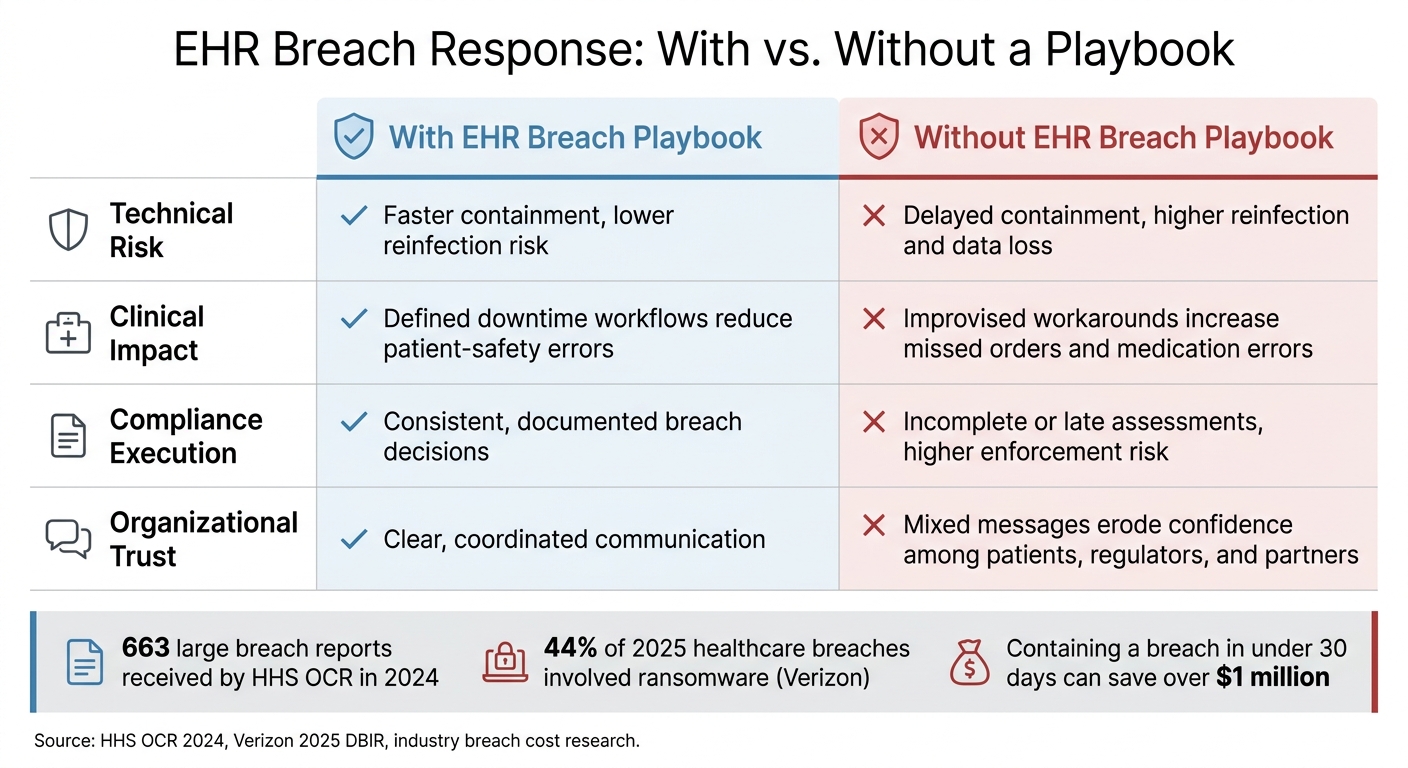
EHR Breach Response: With vs. Without a Playbook
Lower Technical and Clinical Risk Through Faster Containment and Safer Downtime Workflows
When an EHR breach hits, the clock starts immediately. Every minute without a clear plan gives the problem more room to spread, especially as ransomware impacts healthcare delivery and patient safety. Once the workflow is already mapped out, teams don't have to stop and figure out what to do next. They can move fast. That's the core value of a playbook: it gives teams predefined containment steps so they can act at once, before the damage gets worse.[1][6]
Recovery matters just as much as containment. If recovery is rushed or handled out of order, teams can bring the threat back online or damage data during restore. Playbooks help avoid that by requiring validated backups and a fixed recovery order. That cuts reinfection risk and lowers the chance of data loss or restore mistakes.[6][2][13][3]
This structure also helps at the bedside, not just in the server room. During an outage or breach response, clinicians still need a clear way to handle orders, medication administration, and documentation. A playbook lays out that downtime workflow in advance, which helps reduce missed orders, medication delays, and documentation gaps when stress is high.[24][23][25]
Lower Compliance and Reputational Risk Through Consistent Decisions and Documentation
A breach response can also fall apart in quieter ways. One team says one thing, another team says something else, and key decisions never get written down. Playbooks help prevent that drift. Embedded decision points keep HIPAA and HITECH reviews consistent, documented, and ready for OCR scrutiny.[27][28]
The same logic applies to public trust. Reputational damage often grows when updates are late, notices are unclear, or messages don't match. That kind of confusion signals a loss of control. Structured communication templates and clear timelines help organizations speak with one voice and protect trust that can take years to build and only hours to lose.[26][27]
Risk Comparison: With and Without EHR Breach Playbooks
The gap becomes plain when you compare both paths side by side.[6][14][22][2][13][3]
| Aspect | With EHR Breach Playbooks | Without EHR Breach Playbooks |
|---|---|---|
| Technical risk | Faster containment, lower reinfection risk | Delayed containment, higher reinfection and data loss |
| Clinical impact | Defined downtime workflows reduce patient-safety errors | Improvised workarounds increase missed orders and medication errors |
| Compliance execution | Consistent, documented breach decisions | Incomplete or late assessments, higher enforcement risk |
| Organizational trust | Clear, coordinated communication | Mixed messages erode confidence among patients, regulators, and partners |
How to Put EHR Breach Playbooks Into Practice Across the Enterprise
Once your response steps are set, the next move is to turn them into something the whole enterprise can use day to day.
Map Critical Systems and Build Playbooks for the Most Likely EHR Breach Scenarios
Start with a full inventory of the EHR core and every connected system: IAM, SSO, interface engines, lab, imaging, revenue cycle, patient portals, backups, and PHI-sharing vendors. For each one, document the system owner, vendor, data class, dependencies, backup location, and downtime workaround.
Then use that inventory to rank scenarios by likelihood and operational impact. In most healthcare settings, the first playbooks should focus on ransomware, credential compromise, insider misuse, and vendor outages or breaches. These tend to bring both a high chance of happening and a high operational hit.
Trying to write a playbook for every possible event on day one usually backfires. You end up with documents no one uses. It’s smarter to start with the highest-risk scenarios and build from there, since each one calls for a different response path.
Test Playbooks With Tabletop Exercises and Recovery Drills
Tabletop exercises show whether teams can make sound decisions when the pressure is on. They test escalation paths, communication timing, and cross-functional coordination through realistic scenarios. Recovery drills take it a step further. They confirm whether backups can in fact be restored, whether recovery time and recovery point objectives can be met, and whether clinical downtime procedures work in practice instead of just on paper.
These exercises should involve more than the security team. Bring in security, IT, privacy, compliance, legal, clinical operations, communications, and key vendor contacts. That mix matters. A breach rarely stays in one lane.
Every exercise should end with a documented action list that goes straight into playbook updates. Playbooks also need review on a set cadence and after any meaningful change, such as:
- a major EHR upgrade
- a new interface
- an acquisition
- a vendor change
- a security incident
- a regulatory update
At a minimum, review them once a year. If your environment changes often, review them more often.
After each exercise, feed the findings into a central review and revision process.
Use Centralized Risk Operations to Keep Playbooks Current and Tied to Real Risk Data
Playbooks can go stale fast in a complex healthcare environment. Centralized risk operations help keep vendor findings, playbook owners, and contingency plans in one workflow, so a change triggers review right away. Censinet RiskOps™ supports this model for healthcare delivery organizations by linking third-party and enterprise risk assessments, cybersecurity benchmarking, and collaborative remediation tracking. That means a new vendor finding can connect straight to the relevant playbook and contingency plan instead of getting buried in a separate spreadsheet.
At scale, centralized risk operations tend to work better than manual tracking:
| Aspect | Manual/spreadsheet | Centralized risk operations |
|---|---|---|
| Coordination speed | Slower handoffs, more email chasing | Faster assignment, tracking, and escalation |
| Visibility | Fragmented across teams and facilities | Shared view of playbooks, owners, and status |
| Vendor risk insight | Hard to connect findings to playbooks | Vendor issues tied directly to affected scenarios |
| Continuous improvement | Updates depend on manual follow-up | Lessons learned routed into revisions |
| Auditability | Version control can be inconsistent | Clear history of decisions, reviews, and remediation |
For organizations managing multiple hospitals, clinics, and vendors, this model helps cut the risk that one site is still using an outdated playbook while another has already shifted to a revised version. That kind of gap can make breach response uneven at the exact moment consistency matters most.
Conclusion: Playbooks Turn EHR Breach Response Into a Repeatable Risk Control
The comparison above points to a simple takeaway: without a playbook, EHR breach response gets slower and much harder to defend. Organizations that contain breaches in under 30 days can save more than $1 million compared with slower responders. And one review found that 46% of EHR downtime safety events happened when no downtime procedure existed, or when the procedure was not followed.[29][30] That makes playbooks a measurable risk control, not just a file sitting on a shelf.
Why does that happen? Because predefined steps for containment, recovery, and documentation remove guesswork. A playbook turns breach response into a defined, repeatable process, so teams spend less time debating what to do and more time containing the issue, restoring systems, and documenting what happened.
The playbooks that work best combine EHR-specific procedures with clear authority across teams, regular tabletop and recovery drills, and updates based on incidents and exercises. In plain terms, everyone knows their role, the handoffs are clear, and the process gets better each time it's tested.
Keeping playbooks current also matters. Systems change. Vendors change. Regulations shift. Centralized risk operations, such as Censinet RiskOps™, keep playbook ownership, third-party vendor risk management data, and remediation tracking in one workflow, so updates become part of day-to-day risk management instead of a scramble after something breaks.
Done well, EHR breach playbooks make incident response governed, auditable, and always improving - helping protect patients, support compliance, and give leadership more confidence.
FAQs
What should an EHR breach playbook include?
An EHR breach playbook needs to work in the real world. It should help teams respond fast while keeping patient care on track, meeting HIPAA rules, and getting systems back online safely.
At its core, the playbook should spell out who does what, when to escalate, and how to handle common breach scenarios. It should also include standardized documentation, evidence preservation steps, downtime and recovery workflows, and a post-incident review process.
Just as important, it should address PHI risk assessment, chain-of-custody steps, and validation of clinical systems and data flows before restoration. That last part matters a lot. Bringing an EHR back too soon, without checking that data and clinical workflows are working as expected, can create a second problem right after the first one.
Censinet RiskOps™ can help streamline risk assessments and incident response workflows.
Who should own an EHR breach response plan?
An Incident Commander - often the CISO or CIO - usually owns the EHR breach response plan. This person runs the response, keeps the team on schedule, and signs off on major containment steps.
They don’t work alone. A cross-functional team usually supports them, including the Privacy Officer, Legal Counsel, Clinical Operations Lead, and Communications lead. Executive leadership keeps final say over high-stakes calls, such as system shutdowns.
How often should EHR breach playbooks be tested?
Run tabletop exercises for your EHR breach playbook at least twice a year so your team can practice realistic scenarios before the pressure is on. On top of that, schedule technical tests on a regular basis to make sure isolation and recovery steps work the way they’re supposed to.
Any time you have a major incident or a major change inside the organization, go back and review the playbook. Update it as needed. Formal leadership sign-off should happen at least once a year.
