
Healthcare AI risk is shifting from wrong answers to wrong actions. My take is simple: when an AI system can read records, trigger workflows, send messages, or change data, the main problem is no longer just model quality. It is control.
Here’s the short version:
- Agents can act across systems, not just suggest next steps.
- Too much access can expose PHI far beyond the job at hand.
- Vendor sprawl can move patient data into logs, tools, and sub-processors you did not review.
- No human check can lead to bad chart edits, claim issues, scheduling errors, and patient harm.
- The fix starts before launch: clear ownership, least-privilege access, vendor review, logging, kill switches, and incident plans.
In U.S. healthcare, this matters fast because HIPAA does not care whether the actor is a person or software. If an agent touches PHI, writes to the EHR, or sends data to outside systems, you need the same things you would expect from any high-privilege account: tight scope, audit logs, and clear review points.
A few facts stand out:
- HIPAA-related security records, including audit logs, should be kept for at least 6 years.
- If a breach affects 500 or more people, reporting to HHS and the media is due within 60 days of discovery.
- Even a single misconfigured agent can touch dozens of connected platforms in one workflow.
What I like about this article is that it treats agents as workflow risk, not only AI risk. That is the right frame. An agent usually fails because people gave it too much reach, too little review, or too little oversight.
If I were boiling the piece down to one line, it would be this: treat AI agents like non-human staff with system access, not like a simple software feature.
Why AI Agents Are Healthcare's Next Biggest Security Risk | Pranava Adduri
Where Agent Failures Happen in Healthcare
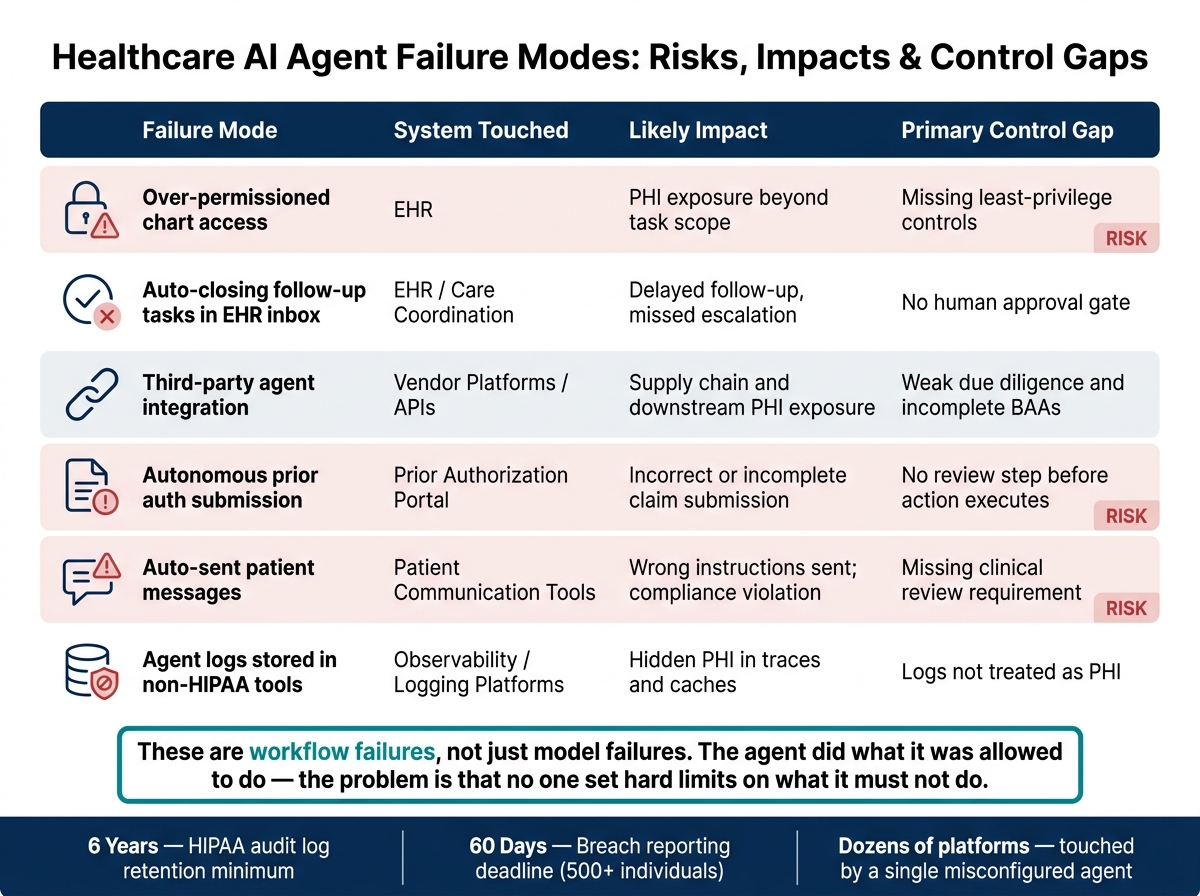
Healthcare AI Agent Failure Modes: Risks, Impacts & Control Gaps
The highest-risk failures tend to show up in three spots: too much access, hidden vendor dependencies, and actions that happen with no human check.
Over-Permissioned Agents Inside EHR and Clinical Workflows
In healthcare, an over-permissioned agent can reach parts of the chart that have nothing to do with the job it was given. For example, an agent built to summarize recent lab results might also be able to read behavioral health notes, reproductive health history, or sensitive messages that are outside the task.
Write access is where the risk jumps. A read-only agent creates limited exposure. A write-capable agent can change the EHR, close tasks, send messages, or kick off workflow steps. If it acts on stale context or missing information, the damage isn't just a poor recommendation. It becomes a live change in the EHR that someone has to spot and fix after care has already been affected. That often violates the Minimum Necessary Standard when agents pull more data than the task calls for [5][7][2].
Third-Party Agent Integrations That Expand Supply Chain Risk
Vendor copilots often come with hidden dependencies: model providers, logging systems, subprocessors, and API calls that aren't visible during procurement [4][7][1][8][9].
That creates downstream vendor exposure. PHI can move to services the organization never reviewed or put under contract. Agent logs, traces, and cached context can also hold patient identifiers, clinical parameters, and message content. If those records sit in logging or observability tools that aren't covered by HIPAA controls, they can create compliance exposure that may not show up until an audit or incident [6][7][1].
Once those dependencies are in place, the next weak point is simple: what the agent is allowed to do without human review.
Autonomous Actions That Create Compliance, Billing, and Patient Safety Problems
Autonomous actions turn into incidents when there's no approval gate between decision and execution. A prior authorization agent might submit incomplete documentation. A patient messaging agent might send discharge instructions before a clinician checks medication changes. A referral agent might send a patient to the wrong specialist or facility. Each of these can trigger operational, billing, compliance, and patient safety problems.
The table below sums up common failure modes, impacts, and control gaps.
| Failure Mode | System Touched | Likely Impact | Primary Control Gap |
|---|---|---|---|
| Over-permissioned chart access | EHR | PHI exposure beyond task scope | Missing least-privilege controls |
| Auto-closing follow-up tasks in the EHR inbox | EHR / care coordination | Delayed follow-up, missed escalation | No human approval gate |
| Third-party agent integration | Vendor platforms / APIs | Supply chain and downstream PHI exposure | Weak due diligence and incomplete BAAs |
| Autonomous prior auth submission | Prior authorization portal | Incorrect or incomplete claim submission | No review step before action executes |
| Auto-sent patient messages | Patient communication tools | Wrong instructions sent; compliance violation | Missing clinical review requirement |
| Agent logs stored in non-HIPAA tools | Observability / logging platforms | Hidden PHI in traces and caches | Logs not treated as PHI |
These are workflow failures, not just model failures. The agent did what it was allowed to do. The problem is that no one set hard limits on what it must not do, or when a person has to stay in the loop.
The next step is to define those limits before deployment.
How to Reduce Agent Risk Before Deployment
A lot of the failure modes described above get smaller when you put controls in place before an agent touches production systems, not after something breaks.
Set Ownership, Inventory, and Approval Boundaries for Every Agent
Risk drops fast when each agent has a clear owner, a defined scope, and an approval path before it goes into production. Keep agents in a central registry that lists the owner, scope, connected systems, data types, and allowed actions.
That registry should include the agent’s name and version, whether it’s internal or third-party, a named business owner, the exact workflows it supports, the systems it connects to, the data types it can access, especially PHI, and what it can and cannot do without human sign-off.
Assign one owner to handle approvals, monitoring, and retirement. If no one owns it, agents tend to collect more access over time, and no one checks whether that access still makes sense.
Approval boundaries should match risk. Drafting an internal summary can be auto-approved. Suggesting a documentation change should go to a staff review queue. Editing an order, sending a message to a patient, or changing a billing code should require explicit human authorization every time.
Once ownership is clear, the next step is simple: lock down identity and permissions before any live connection.
Restrict Agent Access With Least Privilege and Non-Human Identity Controls
Start agents with no standing access. Then grant only the permissions they need for a specific task, environment, and time window. Each agent should have its own identity and short-lived, scoped credentials.
Access should be limited by both data class and action type. For example, a lab-results summarization agent may need read access to recent labs for patients in the active workflow. It does not need full clinical records, bulk patient queries, or write access. A scheduling agent may need appointment availability and contact details, but not full clinical records.
It also matters to keep production and test environments separate. Pilot agents should never touch live PHI or production EHRs until they’ve passed a constrained review.
For higher-impact actions like documentation changes, patient outreach, and payment workflows, enforce step-up approval at the policy layer. Monthly access reviews for high-privilege agents, and at least quarterly reviews for others, help catch privilege creep before it turns into a compliance or safety issue [11].
Then check that vendor access, logging, and sub-processors follow those same limits.
Ask Vendors Deeper Due Diligence Questions About Agent Behavior and Data Handling
Standard vendor questionnaires often miss agent-specific risk. Agents create logs, call outside tools, and can send data to sub-processors that may not be visible in the first contract. So before any third-party agent goes live, the due diligence conversation needs to go past a SOC 2 attestation.
The table below shows the questions that matter most by risk area.
| Risk Area | Questions to Ask the Vendor |
|---|---|
| Data retention and logging | How long are prompts, outputs, and tool-call logs retained? Who can access them? Are they stored in the U.S.? |
| PHI in training data | Are PHI-containing prompts used to train or fine-tune models? Can customers opt out? |
| Sub-processors and fourth parties | Which external APIs, LLM platforms, or observability tools see agent data? Are all sub-processors covered by a BAA? |
| Integration depth | What EHR modules, billing systems, or patient portals does the agent connect to? What actions can it take in each? |
| Testing and safety evidence | Has the agent been red-teamed or tested for prompt injection in healthcare scenarios? Can you provide results? |
| Audit and auditability | Can every action, tool call, and data request be traced to a session and user context? |
If a vendor’s agent touches PHI, the vendor needs a BAA that covers AI data flows, retention, and sub-processors [10][12][13].
After approval, treat each agent like a privileged system, not a passive tool.
sbb-itb-535baee
How to Monitor, Contain, and Respond to Agent Incidents
Once an agent is live, the main risk is no longer approval. It’s drift.
After go-live, agent behavior can change. Vendor updates can change. Integrations can change too. Continuous monitoring helps you see when controls stop working the way you expected.
Monitor Prompts, Tool Calls, Access Patterns, and Downstream Changes
Log the full execution trail, not just the final output. That includes prompts and system instructions, tool calls, human review points, data retrieval paths, API requests, record writes, and outbound messages.
Start with downstream effects first. In healthcare, those are often the places where harm shows up fastest:
- EHR field edits
- Billing code changes
- Scheduling updates
- Referral messages
- Clinical task creation
These actions are the most likely to create patient safety, privacy, or compliance problems. And in practice, the most useful warning signs usually aren’t obvious mistakes. They’re odd patterns. An agent may start querying far more patient records than usual, access charts outside a user’s department, or send messages that don’t match its normal workflow.
Pull logs from orchestration, identity, EHR audit, vendor, messaging, and API systems. Each log entry should show the agent identity, patient or workflow context, tools used, records accessed or changed, human review points that were requested or bypassed, and any failures or exceptions. Keep correlation IDs so investigators can rebuild the full event sequence across systems. If the agent runs through a third-party platform, make sure vendor logs show who initiated the action, what data was read, what action was taken, and whether the action was automated or human-approved. HIPAA documentation rules call for keeping security-related records, including audit logs, for at least six years [14][15].
Alerts should trigger when an agent:
- accesses a patient chart without a matching care need
- makes a large batch of chart edits
- schedules or cancels appointments at unusual scale
- sends messages to patients without review
- initiates billing changes
- tries to use a tool it has not been approved to use
Those patterns can point to misconfiguration, prompt injection, credential compromise, or a workflow that has stretched past its original authorization.
Contain Agent Misuse With Kill Switches and Workflow Isolation
Monitoring matters only if teams can move fast when something goes wrong. Build kill switches before you need them.
Security and operations staff should be able to revoke an agent’s credentials, disable affected integrations, suspend the agent account, and block outbound calls to connected systems without waiting on a vendor.
Containment should be narrow and precise. If one scheduling workflow is affected, isolate that workflow instead of shutting down every AI tool across the enterprise. In clinical settings, route tasks to humans or to a non-agent backup workflow while the review is underway. Stop harmful actions, preserve logs and traces, and bring back only the minimum safe functionality.
It also helps to separate agents by function, environment, and data domain. That limits blast radius. An appointment reminder agent should not share permissions with an agent that drafts prior authorizations or accesses clinical notes.
Prepare Incident Response for PHI Exposure and Agent Actions
When monitoring flags a problem, the response can’t sit with one team alone. Agent incidents often touch security, privacy, compliance, and patient safety at the same time, so those groups need to review the issue in parallel.
Security looks at access and possible compromise. Privacy looks at unauthorized disclosure. Compliance reviews legal duties. Clinical leaders look at patient harm and workflow disruption.
Your incident response plan should cover breach triage, evidence preservation, clinical safety review, documentation correction, and patient communication decision points. Preserve prompts, system instructions, tool-call traces, human review records, access logs, output messages, affected record identifiers, and the agent configuration version that was in use during the incident. Start preservation right away. Some vendors rotate or overwrite logs on short cycles, and that window can disappear fast.
HIPAA breach notification rules require incidents affecting 500 or more individuals to be reported to HHS and the media within 60 days of discovery [16]. Incidents affecting fewer than 500 individuals must be logged internally and reported to HHS no later than 60 days after the end of the calendar year in which they occurred [16].
If the agent changed clinical content, such as medication-related fields, discharge documentation, or scheduling data, include a clinical or operational review to confirm whether the change caused harm or needs correction before the incident is closed.
Governance and Implementation: Building Agent Oversight in Healthcare
Build an AI Agent Governance Model That Connects Security, Compliance, IT, and Clinical Leaders
Once monitoring is in place, governance decides who does what with the issues it finds. Accountability is the first control.
Set up a cross-functional governance committee with your CISO, privacy and compliance officers, IT application owners, clinical leaders, and risk management teams inside your existing ERM and GRC structure. This group should own a written AI agent charter that spells out which agents must go through review, especially those tied to EHRs, billing, scheduling, and clinical support tools, and which minimum controls must be in place before an agent can go live.
Decision rights need to be clear. If everyone owns everything, no one owns anything.
- Security owns technical controls
- Compliance owns regulatory fit
- IT owns integration and change management
- Clinical leaders own patient safety and workflow fit
Each agent should be classified based on PHI access, write capability, autonomy, and vendor exposure. That step matters because write access can turn a workflow mistake into a live system change. High-risk agents that can modify orders, documentation, or claims need security and compliance sign-off before deployment, with clinical leadership reviewing patient safety and workflow impact.
Review these agents at least quarterly and again after any major change, such as a new integration, broader permissions, or a vendor update. The HSCC AI Governance Maturity Model specifically recommends quarterly assessments of AI risk management progress, reinforcing that governance is an ongoing program, not a one-time setup. [3]
Keep AI Risk Decisions Visible and Auditable With Centralized Workflows
To make those decisions stick, centralize them. When agent decisions live in email threads and spreadsheets, the full picture disappears fast, and regulators won't have it either.
Putting AI agent governance into a GRC or risk platform gives every agent one record with its risk rating, access scope, vendor detail, data flow, and approval history. Just as important, log the reason behind each decision. Note why an agent was approved with limits, or why an exception was allowed. That record can matter a lot during OCR investigations or board reporting after an AI-related PHI incident.
A centralized workflow also makes approvals traceable from review through final decision. Censinet RiskOps™ shows what this looks like in practice: its AI governance capability routes findings and tasks to committee members for review and approval, which keeps accountability for high-risk actions clear and approvals out of scattered systems.
Conclusion: Treat Agents as Privileged Actors, Not Just Software Features
Treat agents as privileged actors, and govern them that way from day one.
FAQs
What makes AI agents riskier than AI models in healthcare?
AI agents are riskier than standalone models because they can take action inside EHRs, billing platforms, and clinical workflows without someone checking every step. A standard model usually gives a suggestion. An agent can go further. It can start a workflow, move through systems, and pull sensitive data on its own.
That shift opens much bigger security and compliance gaps. Right now, 63% of organizations can't limit what agents can access or do with patient data, and 60% don't have an emergency shutdown control.
Which healthcare workflows require human approval?
Human approval is a must for AI tools that shape clinical decisions, touch ePHI, or connect with an EHR.
For high-risk workflows - like clinical decision support, diagnostic tools, and care routing - there should always be a person in the loop. That means human review and a clear way to override the system when needed.
AI systems that learn over time need extra guardrails too. If the model changes as it goes, teams should set defined review points and keep a documented change-control plan in place.
And for Tier 3 high-risk tools, the bar is higher. If a tool can act on its own or has read-write EHR integration, it needs formal sign-off before deployment.
How should we audit vendors that use AI agents?
Audit vendors using AI agents as a continuous lifecycle process, not a one-time review. Treat it like upkeep, not a box to check once and move on.
Risk-tier agents based on their impact on patient care and their access to ePHI. And if an agent touches ePHI in any way, make sure a BAA is in place.
During due diligence, map the full AI stack, including fourth parties. Don’t stop at the main vendor. Look at the tools, models, hosting providers, and outside services behind the scenes.
Review AI-specific evidence, change-control plans, and audit logs. Then keep watching for model drift, security issues, and unauthorized subprocessor changes over time.
